5 Ways Medical Practices Quietly Lose Revenue
Learn where revenue cycle management breaks down. Identify 5 key medical billing failure points causing revenue leakage in your practice.
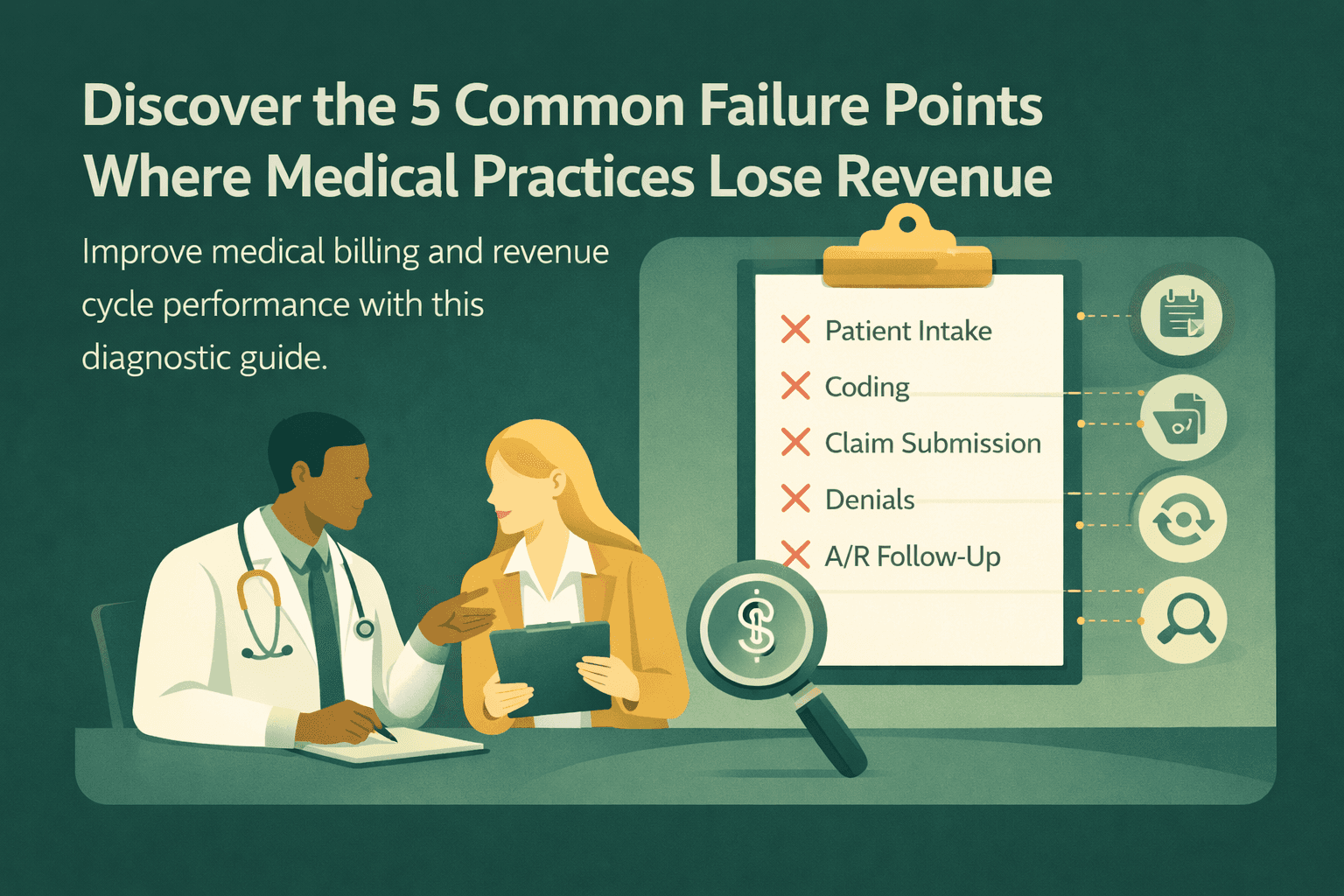
Most revenue loss in a medical practice doesn’t show up as a single, obvious problem. It’s a series of small breakdowns that compound over time.
A missed authorization here.
A delayed claim there.
An underpayment that no one catches.
Individually, they don’t stand out. Collectively, they create meaningful loss.
Most practice owners can identify one or two revenue issues. Very few have visibility into the full picture.
And that’s where the problem sits. Because revenue leakage in healthcare is not random. It follows patterns that are repeatable, identifiable, and, in most cases, preventable. The challenge is knowing where to look.
Revenue Leakage Is a System Issue
When practices think about medical billing and revenue cycle management, they often focus on outcomes:
Collections
Days in A/R
Total charges
Those are important, but they don’t explain why revenue is being lost. Leakage tends to occur at specific points in the revenue cycle. If those points aren’t actively managed, loss becomes part of normal operations.
Across most medical practices, five failure points show up consistently.
1. Eligibility and Authorization Gaps
Before a patient is ever seen, there are two critical checks:
Insurance eligibility
Prior authorization (when required)
When either is incomplete or inaccurate, the claim may still be submitted, but reimbursement becomes uncertain. Industry data suggests that a significant percentage of denials originate from front-end errors, often tied to eligibility or authorization. What makes this challenging is that the issue doesn’t surface immediately. It shows up weeks later as a denial.
Questions to consider:
How consistently is eligibility verified across your locations?
Are prior authorizations tracked and confirmed before the visit?
Do you measure front-end error rates?
Small inconsistencies here tend to create downstream volume in denials and rework.
2. Coding Variability
Even within the same practice, coding can vary more than expected. Different providers document differently. Different coders interpret that documentation differently.
Over time, that variability leads to:
Missed revenue opportunities
Increased audit risk
Inconsistent reimbursement
This is a consistency issue. In practices without regular coding review or feedback loops, performance tends to drift.
Is coding standardized across providers?
Does your perform routine audits or peer comparisons?
Are there noticeable differences in reimbursement by provider that can’t be explained by case mix?
Coding variability rarely creates a single large problem. It creates steady, incremental loss.
3. Claim Submission Delays
Speed matters more than most practices realize. Delays between date of service and claim submission affect:
Cash flow timing
Denial likelihood
Administrative workload
Best-in-class organizations typically submit claims within 24–48 hours of the encounter. When submission is delayed however, issues compound:
Documentation gaps become harder to resolve
Filing deadlines become tighter
A/R cycles extend
Questions to consider:
What is your average time from visit to claim submission?
How often are claims held for missing information?
Are delays consistent across locations or concentrated in certain areas?
Submission delays don’t always feel urgent in the moment, but they have a direct impact on overall revenue cycle performance.
4. Denial Recovery Inconsistency
Most practices have some form of denial management. Fewer have a structured, consistent approach. Denials are worked when time allows. Appeals are submitted, but not always tracked and root causes are identified, but not always corrected.
Over time, this leads to variability in recovery. Industry benchmarks suggest that a meaningful percentage of denied claims are never fully recovered, often due to lack of follow-through or prioritization.
Do you know what percentage of denied claims are successfully recovered? Ask your billing manager or provider how quickly are denials addressed after they occur? Are denial trends feeding back into process improvements?
Denials are not just a billing issue. They are a feedback mechanism.
When they’re not used that way, the same issues tend to repeat.
5. Underpayment Blindness
This is one of the least visible, and most overlooked, sources of revenue loss.
Claims are paid. The balance is closed. The process moves on. But not all payments are correct.
Underpayments can occur due to:
Contract discrepancies
Payer processing errors
Coding interpretation differences
Without a process to validate expected reimbursement, these issues often go unnoticed. Do you have a system to compare expected vs. actual reimbursement? How often are underpayments identified and corrected?
Because these claims are technically “paid,” they rarely trigger follow-up.
Bringing It Together: A Pattern, Not Isolated Problems
Each of these failure points exists independently.
But in practice, they tend to overlap.
An eligibility gap leads to a denial.
A denial is worked inconsistently.
A corrected claim is delayed.
The final payment is slightly under what it should be.
No single step stands out. The system, however, is leaking.
A Simple Diagnostic for Your Practice
If you’re trying to understand where revenue is being lost, start with a focused review:
Front End: Are eligibility and authorization processes consistent and measurable?
Coding: Is there variation across providers, and is it monitored?
Submission: How quickly are claims moving out the door?
Denials: Are they tracked, worked, and used to improve processes?
Payments: Are you verifying that you’re being paid correctly?
Most practices have visibility into one or two of these areas.
Very few have visibility into all five.
Closing Thought
Revenue leakage is rarely dramatic.
It’s subtle. It’s patterned. And it’s often accepted as part of normal operations.
But when you step back and look at the system as a whole, those small gaps add up.
The practices that improve financial performance over time are not necessarily doing more.
They’re identifying where revenue is quietly being lost—and tightening those points with intention.