AI Scribes Are Working—But What Is the Impact on Medical Billing?
AI scribes are saving time—but not increasing revenue. See how medical billing and revenue cycle issues limit financial results.

Artificial intelligence scribes are quickly gaining traction across healthcare, particularly in specialties like primary care, internal medicine, and increasingly in procedural settings such as podiatry. Documentation has long been one of the most time-consuming and frustrating parts of clinical practice, often spilling into evenings and contributing to burnout.
A recent study published in JAMA Network Open and summarized by Healthcare Dive followed more than 8,500 clinicians across five academic medical centers. The findings showed modest but measurable improvements.
Clinicians spent about 13 fewer minutes per day in the EHR and roughly 16 fewer minutes on documentation. Some groups, including primary care providers, experienced even greater time savings.
There was also a slight increase in productivity, with clinicians averaging about half an additional patient visit per week. Financially, that translated into approximately $167 in additional monthly revenue per provider.
Those numbers are positive. But they are also revealing.
They suggest that while documentation is improving, the business itself is not meaningfully changing.
The Gap Between Efficiency and Reimbursements in Medical Practice
If documentation becomes faster and easier, the expectation is that revenue should follow. Better documentation should support stronger coding and cleaner claims. In theory, that should improve medical billing performance and ultimately increase collections.
But the data tells a different story.
An incremental $167 per month per clinician is not enough to materially impact a practice’s financial trajectory. It indicates that efficiency gains are being absorbed rather than converted. The system is becoming slightly more efficient, but not significantly more profitable.
This suggests that documentation was not the primary constraint to begin with. It was simply the most visible one.
Where Clinical Revenue Is Actually Won or Lost
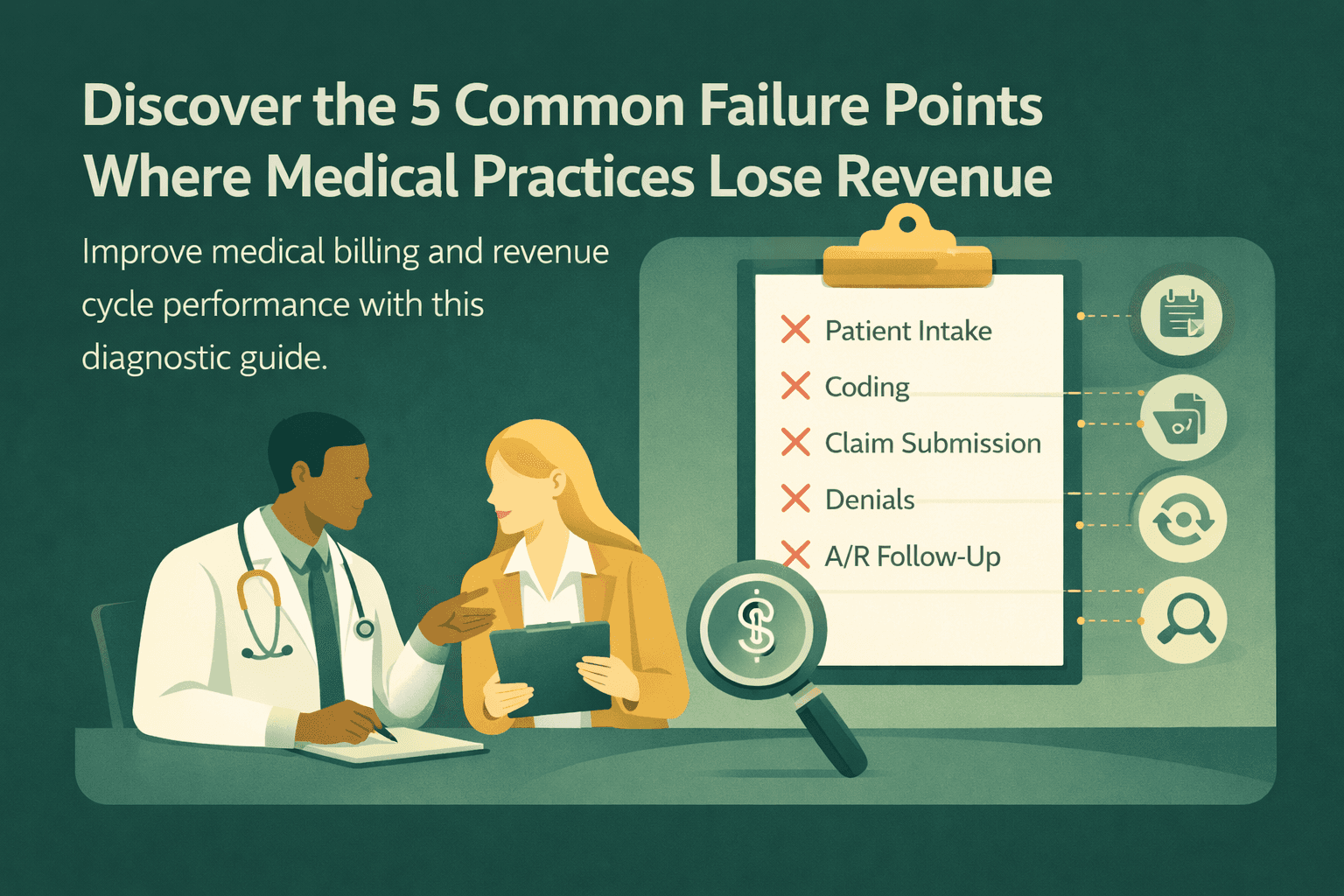
In specialties like podiatry, primary care, and internal medicine, revenue depends on a sequence of events that extend well beyond the clinical encounter. A visit must be properly documented, but it must also be accurately coded, submitted efficiently, adjudicated correctly, and ultimately paid at the expected rate.
This is the domain of medical billing and revenue cycle management, and it is where most of the financial variation occurs.
A well-documented visit will still fail to generate revenue if eligibility is incorrect at the front desk. A clean note will not accelerate cash flow if the claim is delayed in submission. Even when payment is received, there is no guarantee it reflects the contracted rate unless there is a system in place to verify it.
These breakdowns are often subtle, but they are persistent. They occur across thousands of transactions and quietly compound over time.
When viewed this way, the study’s findings make sense. Improving documentation removes one source of friction, but it does not address the larger system where revenue is actually captured or lost.
What the Study Quietly Confirms
The most important takeaway from the data is not that AI scribes are underperforming. It is that they are solving a problem that, while real, is not the primary driver of financial performance.
If documentation were the limiting factor, reducing it by 15 to 25 minutes per day would have produced a more meaningful increase in revenue. The fact that it did not suggests that the constraint lies elsewhere.
In many practices, particularly in high-volume specialties like primary care and procedural fields like podiatry, the true constraint is the ability to consistently convert clinical activity into cash. That conversion depends on the strength of the revenue cycle, not just the speed of documentation.
AI Scribes Without Strong Medical Billing Doesn't Improve Revenue
AI scribes are delivering on their promise to reduce documentation burden. The data shows clear improvements in efficiency and modest gains in productivity. These are meaningful steps forward for clinicians.
But the expectation that these tools will materially improve financial performance on their own is not supported by the evidence.
The reason is straightforward. Financial performance in healthcare is not determined by how quickly care is documented. It is determined by how effectively that care is translated into reimbursement through the medical billing process.
Until that system is addressed, the impact of AI will remain incremental.
For practices that recognize this, however, the opportunity is larger. Not because AI changes the economics directly, but because it creates the conditions to improve the system that does.